
21st Century Medicine (21CM) is a cryobiology research company whose core mission is to develop a cryopreservation protocol benign enough that whole donated human organs could be vitrified — stored below −130 °C without ice formation — and rewarmed for transplantation. 21CM's scientists are pioneers of whole-organ vitrification, and their state-of-the-art techniques are the basis of the human cryopreservation protocols used by some cryonics organizations. Two key publications are "Cryopreservation of organs by vitrification" (Fahy et al. 2004) and "Physical and biological aspects of renal vitrification" (Fahy et al. 2009).
21CM has been an official competitor in our Brain Preservation Prize since 2012, with two separate techniques: the "straight" cryopreservation/cryonics technique described here, and the newer Aldehyde-Stabilized Cryopreservation developed to overcome the tissue-shrinkage problems below.
In the "straight" technique, an anesthetized animal's brain is perfused with increasing concentrations of cryoprotectant agent (CPA) as temperature is lowered. To prevent all ice formation down to −130 °C, most of the water must be removed from the brain and replaced with concentrated CPA. For technical reasons this cannot be done without severe osmotic shrinkage: the protocol shrinks the brain by roughly 50%, and 21CM has so far been unable to reverse this prior to electron-microscopic evaluation — making it very difficult to assess how well the connectome is preserved.
"A typical M22 brain shrinks from a normal 10 grams to typically 5 grams or less due to the osmotic effect of M22… the volume within cells, axons and dendrites probably declines by around 70%… synapses, which are recognized by their blackness, become hard to see." — researchers at 21CM
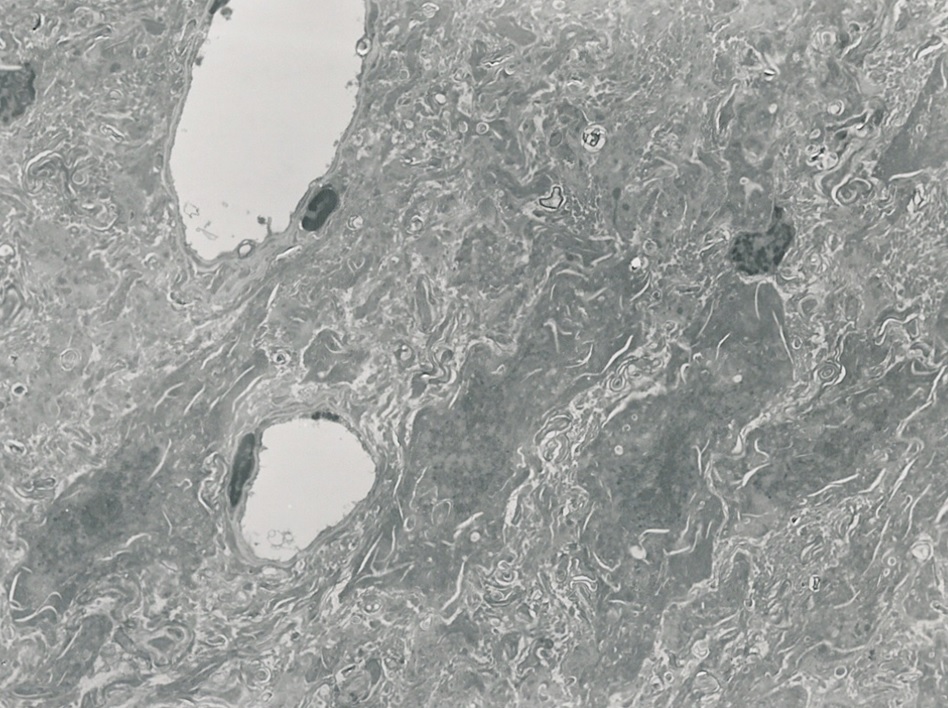
The resulting whole-brain images were disappointing relative to the textbook-quality ultrastructure neuroscientists expect, because of this severe osmotic shrinkage. 21CM has continued to work toward a protocol that eliminates or reverses the shrinkage.
In stark contrast, similar CPA formulas applied to half-millimetre-thick living brain slices show good ultrastructure preservation and remarkable recovery of function after rewarming from weeks at −130 °C. 21CM published two papers on this: "Cryopreservation of rat hippocampal slices by vitrification" (Pichugin, Fahy & Morin 2006). 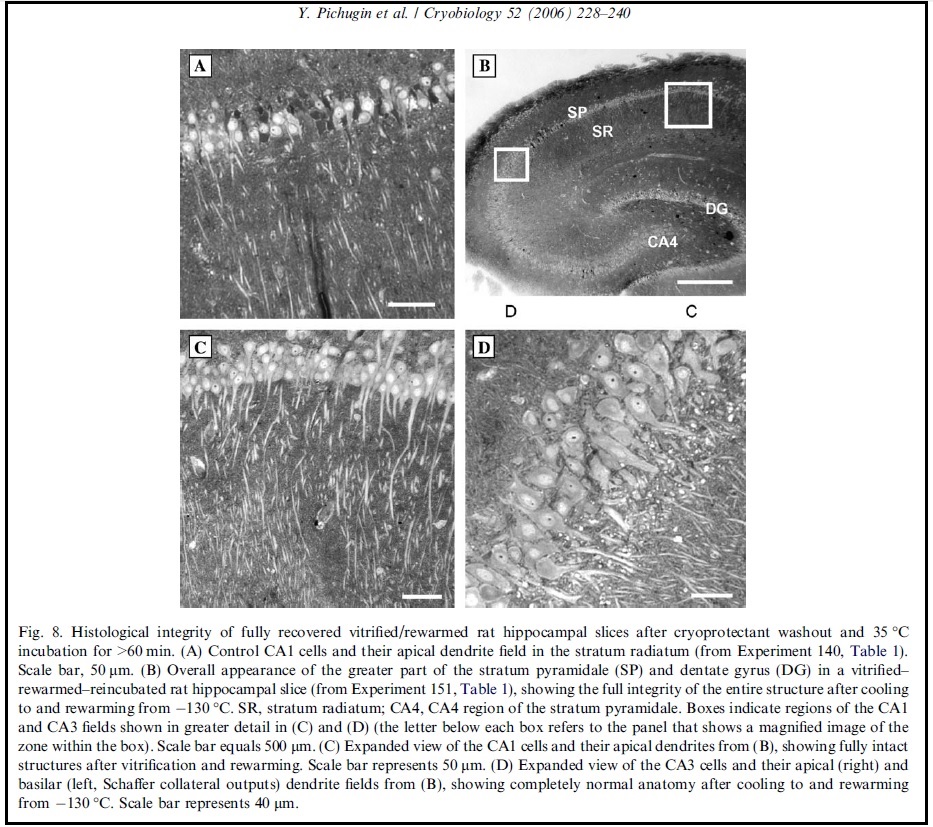
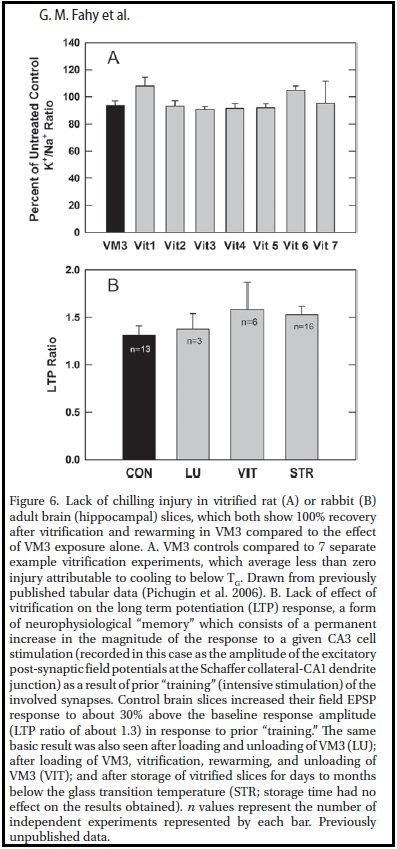
In summary, 21CM's "straight" technique eliminates ice crystals but at the cost of severely shrinking the brain. If that shrinkage could be avoided or reversed, one would expect similarly good preservation as in the slice work.