A technology designed to preserve synapses across the whole brain of a large mammal has succeeded.
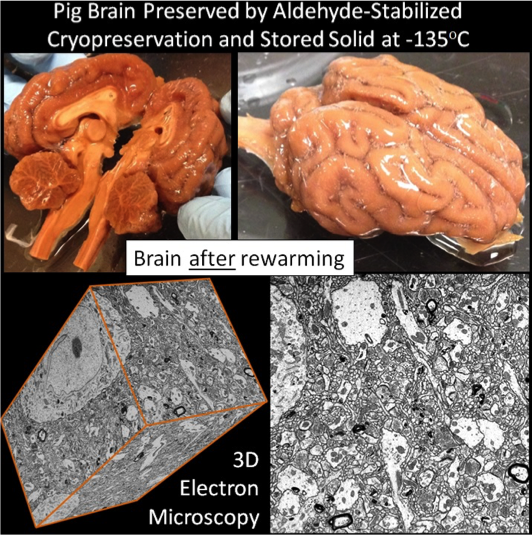
Using a combination of ultrafast glutaraldehyde fixation and very low-temperature storage, researchers have demonstrated for the first time a way to preserve a brain's connectome — the roughly 150 trillion synaptic connections presumed to encode all of a person's knowledge — for centuries-long storage in a large mammal. This laboratory demonstration clears the way to develop Aldehyde-Stabilized Cryopreservation (ASC) into a "last resort" medical option that would prevent the destruction of a patient's unique connectome, offering at least some hope of future revival via mind uploading.
"The neuroscience and medical communities should begin an open debate regarding ASC's ability to preserve the information content of the brain." — BPF President Ken Hayworth
The Brain Preservation Foundation's Large Mammal Brain Preservation Prize was won by the cryobiology research company 21st Century Medicine (21CM), lead researcher Aurelia Song (formerly known as Robert McIntyre) — an MIT-trained scientist and co-founder of the startup Nectome — and senior author Greg Fahy. The prize required successful preservation of synaptic connectivity across an entire pig brain in a manner compatible with centuries-long storage. The team scaled up the same procedure used to preserve a rabbit brain, for which they won the BPF's Small Mammal Prize in February 2016, narrowly beating a team led by Prof. Shawn Mikula at the Max Planck Institute (published in Nature Methods).
ASC, published in a peer-reviewed journal by McIntyre and Fahy in 2015, consists of perfusing the brain with glutaraldehyde and cryoprotectant prior to very low-temperature storage. Extensive 3D electron microscopy, alongside detailed evaluation by the BPF's judging committee, verified the quality of connectome preservation after rewarming the pig brain from cold storage. For this achievement the researchers were awarded a prize purse of $80,000. The Brain Preservation Prize was funded through a $100,000 pledge made by serial entrepreneur Saar Wilf in 2010.
The researchers did not revive a pig or a pig brain. The first step in ASC perfuses the brain's vascular system with the toxic fixative glutaraldehyde, instantly halting metabolism by covalently crosslinking the brain's proteins in place. This leads to death by contemporary standards (though not necessarily by information-theoretic standards). Such irreversible crosslinking makes future biological revival exceedingly impractical. The point of the procedure is most clear from the possibility of future non-biological revival.
A growing number of scientists and technologists believe future technology may be capable of scanning a preserved connectome and using it as the basis for a whole-brain emulation — uploading that person's mind into a computer controlling a robotic, virtual, or synthetic body. The Brain Preservation Prize challenged the scientific community to build a "bridge" to that future technology, focused on provably preserving the information content of the brain.
Further reading: Letter of support from Kenneth Hayworth for developing aldehyde-stabilized cryopreservation into a validated medical procedure (PDF, January 2018).