
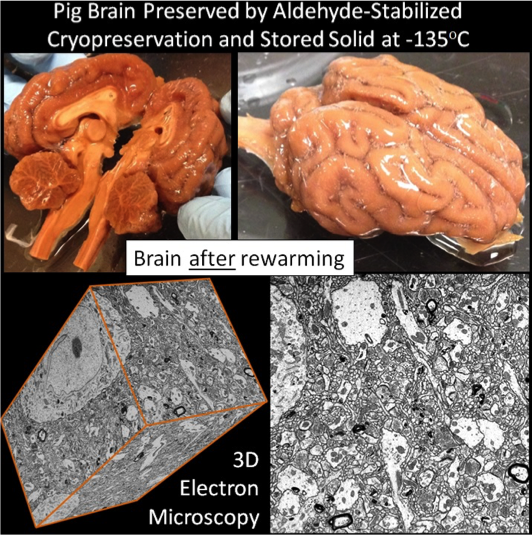
In early 2015, 21st Century Medicine began a new set of experiments — spearheaded by recent MIT graduate Robert Louis McIntyre (now Aurelia Song), with funding from the BPF — designed specifically to meet the Brain Preservation Prize. Their "straight" cryopreservation had shown that a brain could be perfused to a sufficient CPA concentration to prevent ice formation down to −130 °C; the drawback was the roughly 50% osmotic shrinkage that made connectome evaluation virtually impossible.
The key idea: instead of perfusing the living brain directly with CPA, first perfuse it with an aldehyde fixative, then CPA. Glutaraldehyde is routinely used as the first step in preparing brain tissue for electron microscopy; within minutes it halts almost all decay by crosslinking proteins in place. "Aldehyde stabilising" the brain this way allows CPA perfusion to proceed under more optimal conditions, avoiding osmotic dehydration and shrinkage.
This reasoning proved correct. A whole rabbit brain perfused with glutaraldehyde and then with a vitrifiable concentration of CPA showed no gross shrinkage; after storage at −135 °C and rewarming, the ultrastructure looked almost identical to aldehyde-only controls — close to "textbook normal." 21CM tested the procedure on several whole rabbit and pig brains, producing dozens of electron micrographs showing a stunning degree of ultrastructure preservation across the entire brain. The results were published, open-access, in the Journal of Cryobiology (McIntyre & Fahy, 2015).
ASC avoids the plastic-embedding and aggressive organic-solvent steps required by some other protocols, and does not require osmium, avoiding its expense and penetration issues. Because glutaraldehyde preserves the sequential structure and positions of proteins, ASC results in relatively few molecular-level changes. The near-instant initial fixation also locks crucial molecules — ion channels, receptor proteins — in place, allowing the subsequent CPA step to be optimised purely for structural preservation. (Aldehyde-stabilized cryopreservation was, notably, discussed as far back as chapter 9 of Eric Drexler's 1987 book Engines of Creation.)